

Our "shaking, touching, heart-touching"
I was able to become someone who could "take on challenges" thanks to the supportive environment and teachers I encountered.
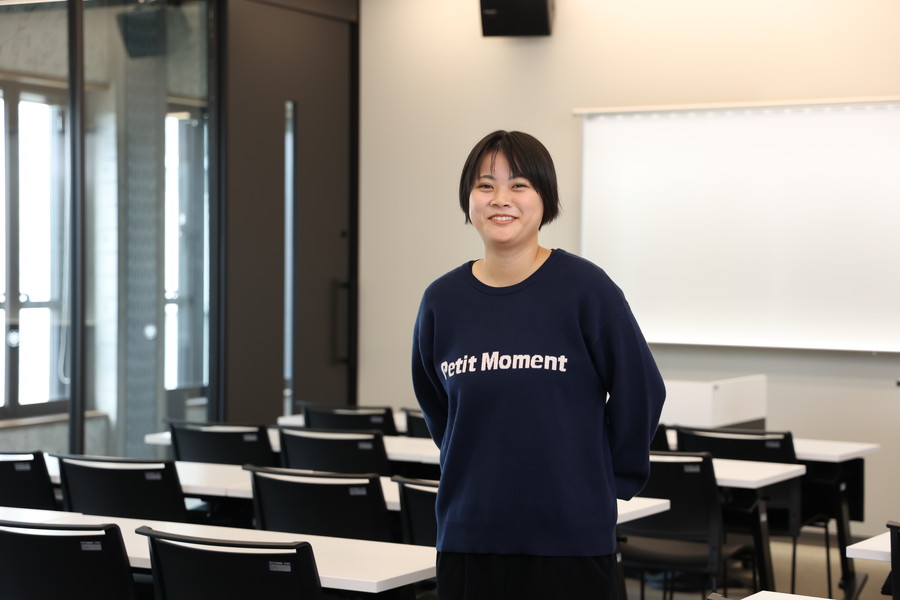
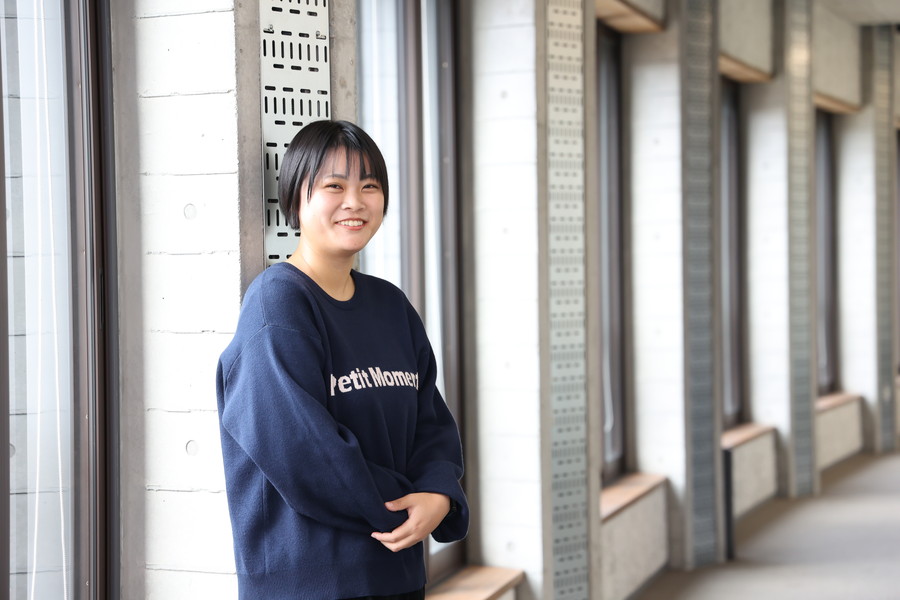
Matsuiro Mihori
My encounter with Faculty of Business Administration, and the start of living alone.
I dedicated myself to soccer from elementary school through high school. My love for Vissel Kobe and my desire to live in the Kansai region, where my older brother was living alone, led me to consider attending a university in Kansai. While searching for a university, I became interested in Business Administration, and when I learned that Otemae University was establishing a new Faculty of Business Administration, I participated in their open campus and trial classes.
I met Professor Kitamura, who is currently my seminar instructor, during a trial lesson. In the lesson, he said, "Faculty of Business Administration is suitable for people who enjoy entertaining and pleasing others," and I was strongly drawn to those words, thinking, "That's it!" My interest in being involved with organizations through soccer, and the appeal of the university's unique "crossover system," were also reasons why I decided to enroll. I felt reassured knowing that there is an environment that can flexibly adapt even if my field of study changes in the future.
I feel that studying in Faculty of Business Administration is not just about inputting knowledge, but also a time to continuously think about "how I want to work" and "what kind of professional I want to become." In this faculty, from the first year, there are many opportunities to talk about employment and careers through one-on-one interviews and group work, and professors who have actual work experience in companies share their own experiences, so it is possible to concretely imagine what the future holds.
There are certainly a lot of reports and assignments, but I feel that this has naturally helped me develop the ability to organize my thoughts and express them in words. My mother was surprised, saying, "It's rare to have such a close relationship with university professors," and I myself am very grateful for this environment.
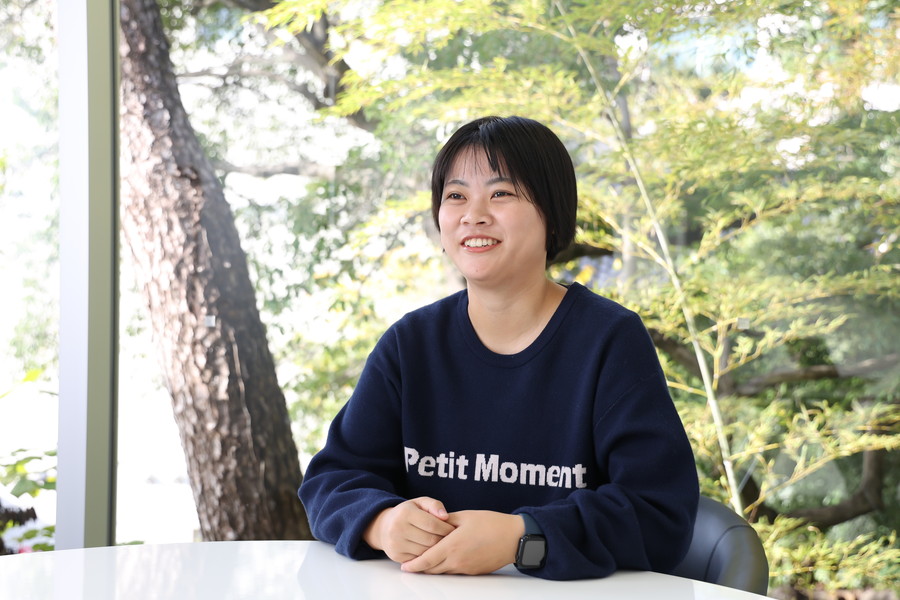
An interview with a working woman in my seminar changed my perspective on job hunting.
Since my third year, I have been a member of Professor Kitamura's seminar, where I am researching organizational behavior, particularly focusing on "motivation." First, I read literature on human resource management and utilization to learn the theory, and then I began interviewing young women working in companies.
In the interview, she spoke frankly about her job responsibilities, what she finds rewarding about her work, and what she values most in her career. To be honest, I didn't have a very good image of "employment" before that. I was worried that it would be busy when I was young, and that my role would be limited simply because I was a woman.
However, what was truly impressive was how everyone took pride in their work, and how they were working vibrantly while feeling a sense of growth and accomplishment. Seeing them changed my perception of working in society significantly, and I began to think more positively about finding a job. Also, although I had a strong desire to work for a company related to soccer, this experience broadened my perspective, and I began to think that I could consider a wider range of options.
We analyzed the interview results on the theme of "job satisfaction," and presented our findings, what we learned, what differed from our expectations, and our suggestions to the company in a seminar presentation. We also had company representatives review our presentation, and when we suggested that "in addition to company policies, perhaps you should convey more about employee job satisfaction during company information sessions," we received feedback that "we would like to ask our employees about job satisfaction again." This realization that our learning could potentially connect to actual business activities gave us a great deal of confidence.
A short-term training program in Taiwan that became a turning point for me.
In the summer of my third year, I participated in a short-term training program in Taiwan (a program offered by Faculty of Business Administration) that lasted about a week. Although I was interested in going abroad, I was hesitant to participate because I wasn't confident in my English skills. However, I decided to go because I wanted to "give it a try."
While there, I had the opportunity to interact with students from many different countries, and I was struck by how everyone spoke about their dreams in their own words. I'm not good at speaking in front of others and tend to get nervous when expressing my opinions, but in Taiwan, there was a lot of opportunity to speak up in class, and there was an atmosphere where it was okay to make mistakes, so I was happy that I was able to speak up more naturally.
During group work, I received many questions from students from Africa, and I remember the experience of desperately trying to communicate with them using gestures. I realized that even if your language skills aren't perfect, you can still communicate if you have the willingness to communicate. Professor Kitamura had also told me that I should be more confident, and through my experience in Taiwan, I feel that I've gradually become more confident in myself.
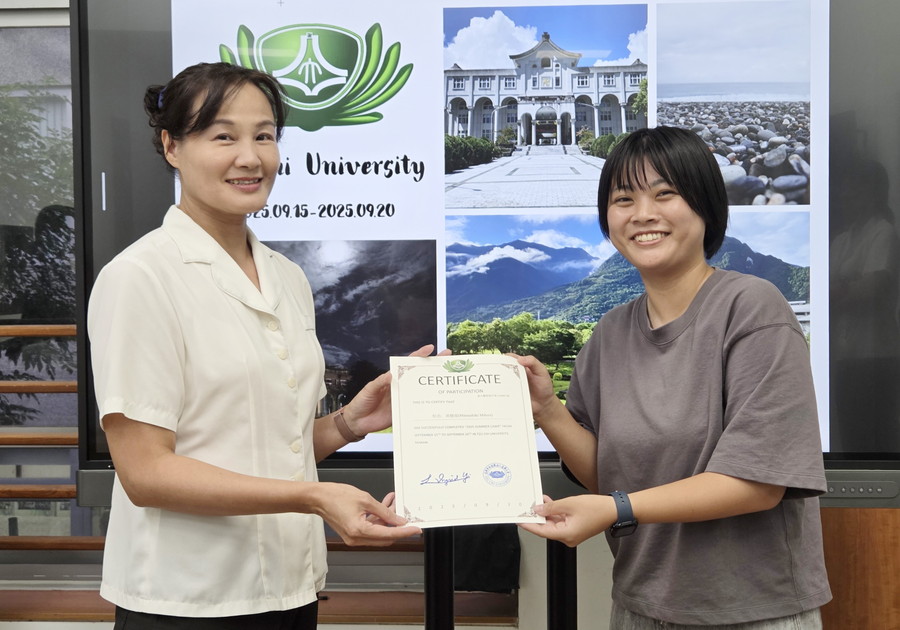
Furthermore, although the classes and interactions during the training were primarily conducted in English, there were also Chinese language classes, which was a refreshing experience as I encountered a language I had never had the opportunity to speak before. I was also deeply moved by the hospitality of the Taiwanese students who provided support for my daily life from morning till night, and it significantly changed my perception of overseas travel.
The presence of teachers who genuinely care about the lives of each and every student.
Because our university is relatively small, I feel that the relationship between professors and students is very close. I was particularly impressed by how professors, including Professor Kitamura in my seminar and Professor Miyake, who helped me during my first year, went out of their way to support each individual and bring out their best qualities.
Because they observe not only my academic performance but also my daily behavior and way of thinking, I sometimes receive advice from unexpected perspectives. Having time to talk frankly with my advisor about my career path and anxieties about the future allowed me to move forward without getting stuck when I was unsure.
When I lived in my hometown, I played soccer, so I was often given leadership roles, and I unconsciously believed that I had to be someone who could do anything. I liked being relied on and making people happy, but I think I often kept unpleasant things to myself without being able to honestly say what I didn't like. However, at university, I gradually started to relax... I feel that the environment where I was accepted even if I wasn't perfect changed me.
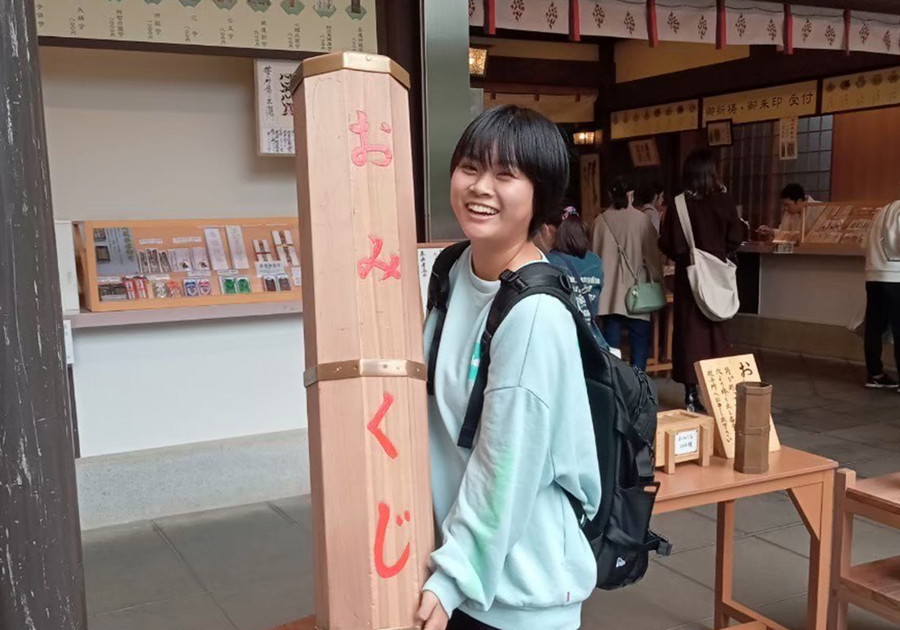
Living alone in the Kansai region also helped me grow as a person. When I participated in a workshop at an elementary school as part of a field study in my first year of university, I was overwhelmed by the strong personalities of the children (laughs).
In an environment where many people, from children to adults, have strong personalities, I learned how to express my opinions with the strong support of my teachers, and I think I gradually became able to speak up. Also, with the money I saved from my part-time job, I was able to broaden my horizons by taking solo trips to various parts of Japan and even traveling abroad.
Furthermore, I learned about the recruitment of student sports promoters for a women's soccer club through the university's internal system, applied, and had the opportunity to volunteer in match operations and implement student-developed projects at actual match venues. It was an invaluable experience to see the club staff's work up close on-site, and I am also involved in soccer match operations as an event staff member through a part-time job, so I am realizing that learning and practice are gradually connecting.
No matter what industry I enter in the future, I want to be involved in work that brings joy to people and makes them feel positive. Having seen through soccer how possibilities can be limited by "environment," I have a strong desire to be involved in work that creates "an environment where everyone can take on challenges."
I hope to continue challenging myself with training programs in New Zealand and Taiwan, and use the knowledge I gained at Otemae University to grow into a person who can contribute to society.
*All information is based on interviews conducted at the time. (April 2026)