News & Press Releases
[Public Lecture] June Lecture: "Understanding 'Architecture and Cities' from a Maritime Perspective"
2026.06.15
- Public Lectures
The 2026 public lecture series will be held throughout the year with the main theme of "Recommendations for Appreciating Architecture and Urban Planning."
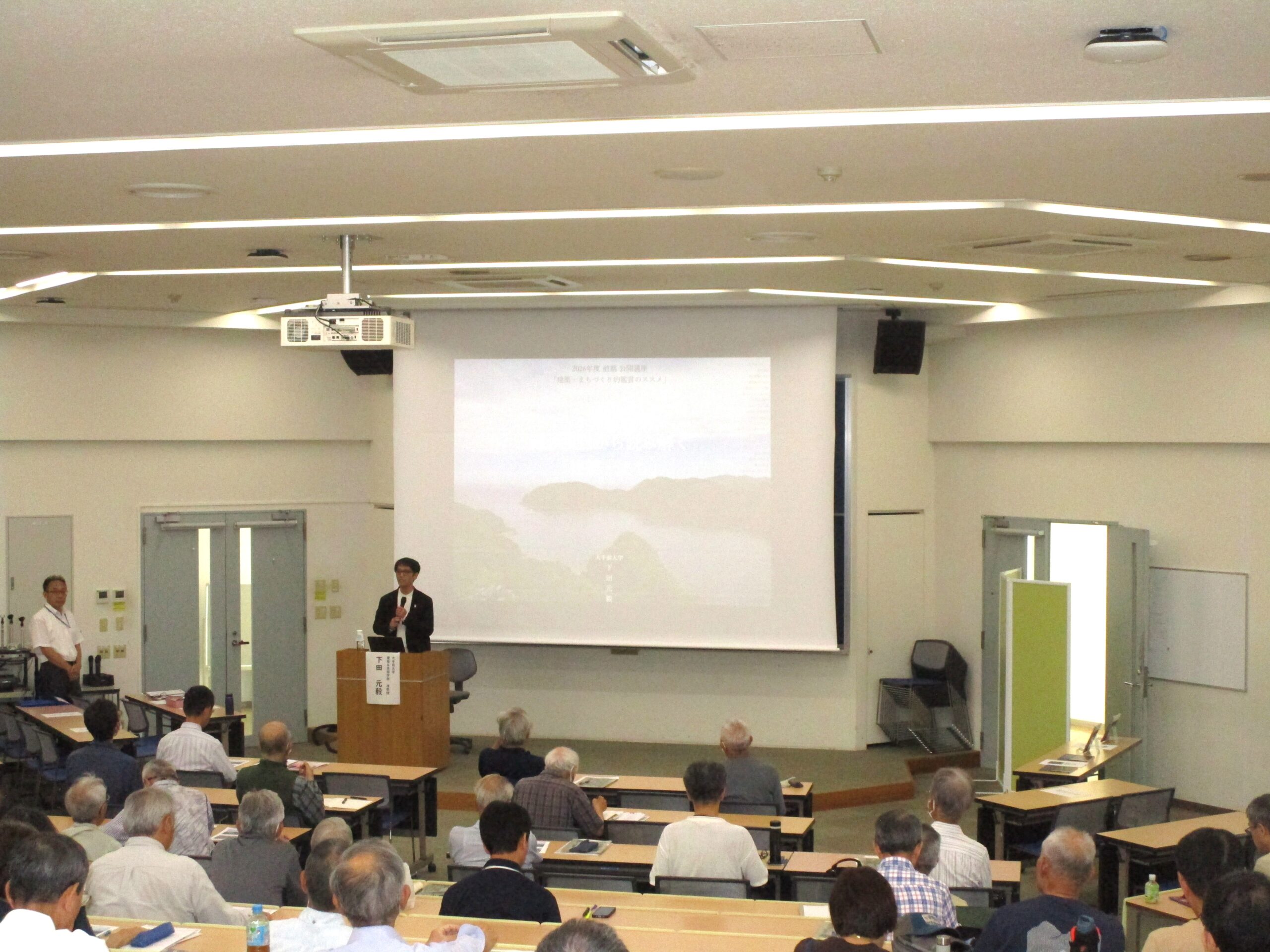
The third session of the first semester was held on Saturday, June 13th, with the theme "Understanding 'Architecture and Cities' from a Maritime Perspective," presented by Professor Motoki Shimoda, Lecturer at Faculty of Architecture & Arts Otemae University. 110 people attended.
Professor Shimoda specializes in Architecture and disaster prevention in fishing villages, and this time he focused particularly on Ine Town in Kyoto Prefecture and Kuki Fishing Port in Owase City, Mie Prefecture.
The explanation that "Ine no Funaya" (boathouses of Ine) has become a leading tourist destination in northern Kinki since being designated as an Important Traditional Building Preservation District in 2005, and that its current landscape was the result of the "modernization of fishing methods" and the "modernization of infrastructure" by the government in the early Showa period, and that the landscape is both "traditional" and at the same time has the appearance of "modern Architecture," was particularly impressive.
Kuki Fishing Port is known as the base of the "Kuki Navy," but because it is located at the back of an inlet on a ria coast, Professor Shimoda is researching it from the perspective of pre-earthquake reconstruction planning in the event of a Nankai Trough earthquake. After interesting explanations of the unique festival "Nirakura" that has been held in the Kuki area for a long time, the "approach road" and "funeral road" leading to the temple, and the "Burikabu (fishing stock system)," which is one of the communities that supports these traditional cultures and was established in the early Meiji period and still exists today, Professor Shimoda's explanation was impressive, emphasizing that activities that continue to connect the land (hometown) and people, based on the traditions of the area, are indispensable for pre-earthquake reconstruction planning. These activities include holding an event called "Bocchi de Nagashi Somen" which re-examines the "Bocchi," a "water jar" that was formerly used, as reconstruction infrastructure in the event of an earthquake, and activities to refurbish a closed elementary school as an evacuation center.
The next session will be held on Saturday, July 11th, and will focus on the theme of "Earthquakes that may occur in the Kansai region in the future and an introduction to structural technologies developed to ensure safety."
(Source: Regional and Social Cooperation Office)