News & Press Releases
[Faculty of Business Administration] Lecture by Mr. Mikio Kobayashi, President and CEO of Leon Automatic Machinery Co., Ltd.
2026.07.06
- Faculty of Business Administration
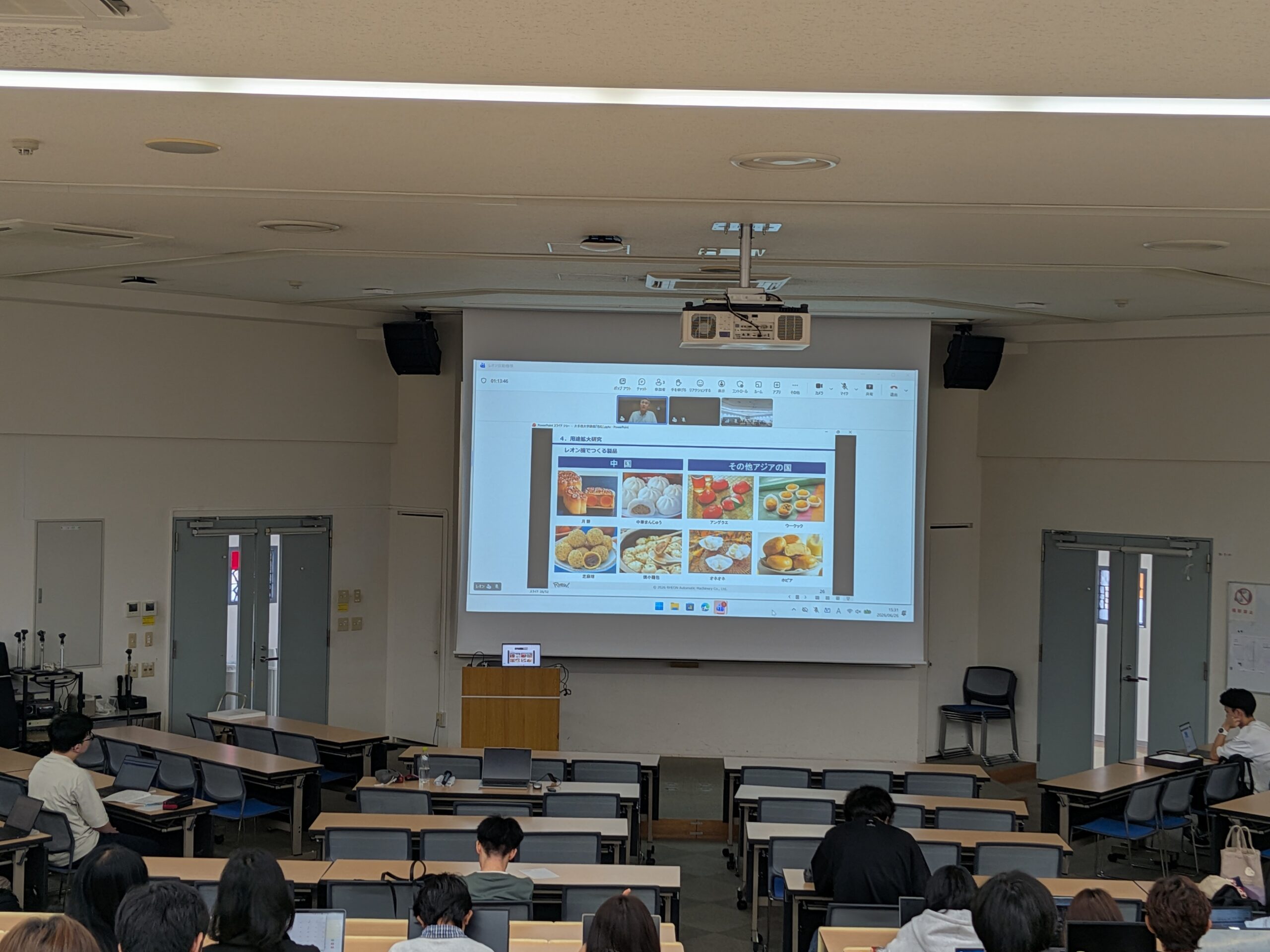
In the "Food Marketing" course taught by Assistant Professor Mizuyo Toma of Faculty of Business Administration, the aim is to enable students to develop their own thoughts and perspectives on food, which is essential for our lives, based on marketing knowledge, including SDGs and waste issues. This time, we had the pleasure of hearing from Mr. Mikio Kobayashi, President and CEO of Leon Automatic Machinery Co., Ltd., who developed Japan's first "filling machine" for confectionery making in 1963 and is active in the food industry worldwide.
Initially, the students were unable to imagine the unfamiliar term "wrapping," nor could they picture how Leon Automatic Machinery's machines were used or how confectionery was made. Through President Kobayashi's lecture, they were able to learn about food manufacturing, something they had never paid attention to before. President Kobayashi began by explaining why the founder, Torahiko Hayashi, a wagashi (Japanese confectionery) craftsman, came to develop the "wrapping machine," his passion for the wagashi industry, wagashi craftsmen, and wagashi, and the numerous hardships he overcame to develop the "wrapping machine," as well as the meaning of "rheology," which is also in the company name. He also spoke about Leon Automatic Machinery's development policy, which includes "not imitating other companies," "developing unique technologies," and "selling standard machines." He then explained that although there are differences in food ingredients around the world, food is made up of the process of "wrapping," and that this has led Leon Automatic Machinery to expand its research and development beyond wagashi manufacturing machines to include Western confectionery, prepared foods, and bread. Furthermore, as its applications expanded, the company began overseas expansion less than ten years after the development of its "filling machine," and now exports its products to 132 countries worldwide (80 in Europe, 26 in Asia, and 26 in the Americas). It is clear that the company is currently expanding its overseas market and is truly supporting the global food industry. In addition, we received a detailed lecture lasting about an hour on other important aspects of Leon Automatic Machinery's marketing.
Students commented, "I was particularly impressed by the statement that manufacturing is not simply about making products, but about supporting people's lives and food culture," "I felt that Leon Automatic Machinery is a source of pride for Japanese companies," and "The explanation that new ideas cannot be born if everyone in the company thinks the same way, and that people with diverse ways of thinking and cultures are what lead to the company's growth, was a great encouragement to me as an international student."
(Source: School Public Relations)