

News & Press Releases
[Public Lecture] October Lecture: "Decoding the Urban History of Modern and Contemporary Kobe from Historical Records"
2026.10.13
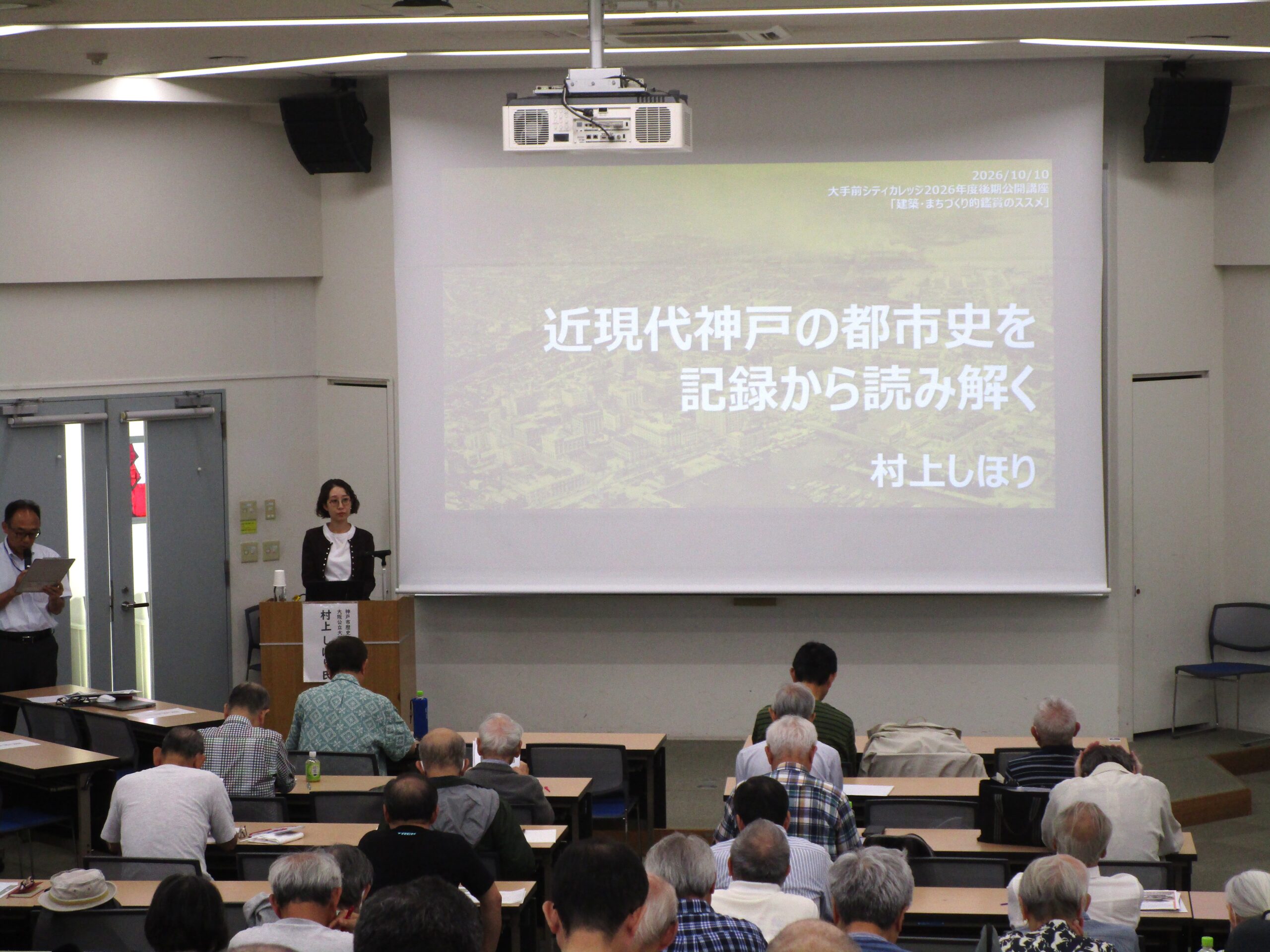
The 2026 public lecture series will be held throughout the year with the main theme of "Recommendations for Appreciating Architecture and Urban Planning."
The second session of the second semester was held on October 10th (Saturday) and featured a lecture by Ms. Shihori Murakami, Section Chief of the Kobe City Historical Archives and Specially Associate Professor at Osaka Metropolitan University, on the theme of "Decoding the Urban History of Modern and Contemporary Kobe from Historical Records." 128 people attended.
Mr. Murakami explained that in order to understand cities and Architecture, it is important to decipher "urban history" by using the remaining records as clues. At the beginning of his lecture, he explained about the Kobe City Historical Archives, where many official documents and photographs are preserved, and how to utilize them, as well as the fact that he himself was involved in their organization.
Next, the urban history of Kobe was explained, based on maps, photographs, and other records preserved at the Kobe City Historical Archives, covering topics such as "the opening of Kobe Port and the establishment of Kobe City during the Meiji and Taisho periods," "urban planning, disasters (floods), and city development in the early Showa period," "post-war black markets, occupation, urban development, the development of shopping streets under elevated railways, and the development of the city center centered around the city hall," "changes in Kobe Port," and "earthquake reconstruction and redevelopment in the Heisei and Reiwa eras."
Finally, the presentation concluded with the explanation that, "While someone's account of the town or their feelings towards it may be recorded, it is not necessarily historically accurate. It is important to base investigations on 'records' that contain accurate information, and it is crucial to establish a system for preserving and managing these 'records' so that everyone can use them appropriately."
<Source: Regional and Social Cooperation Office >